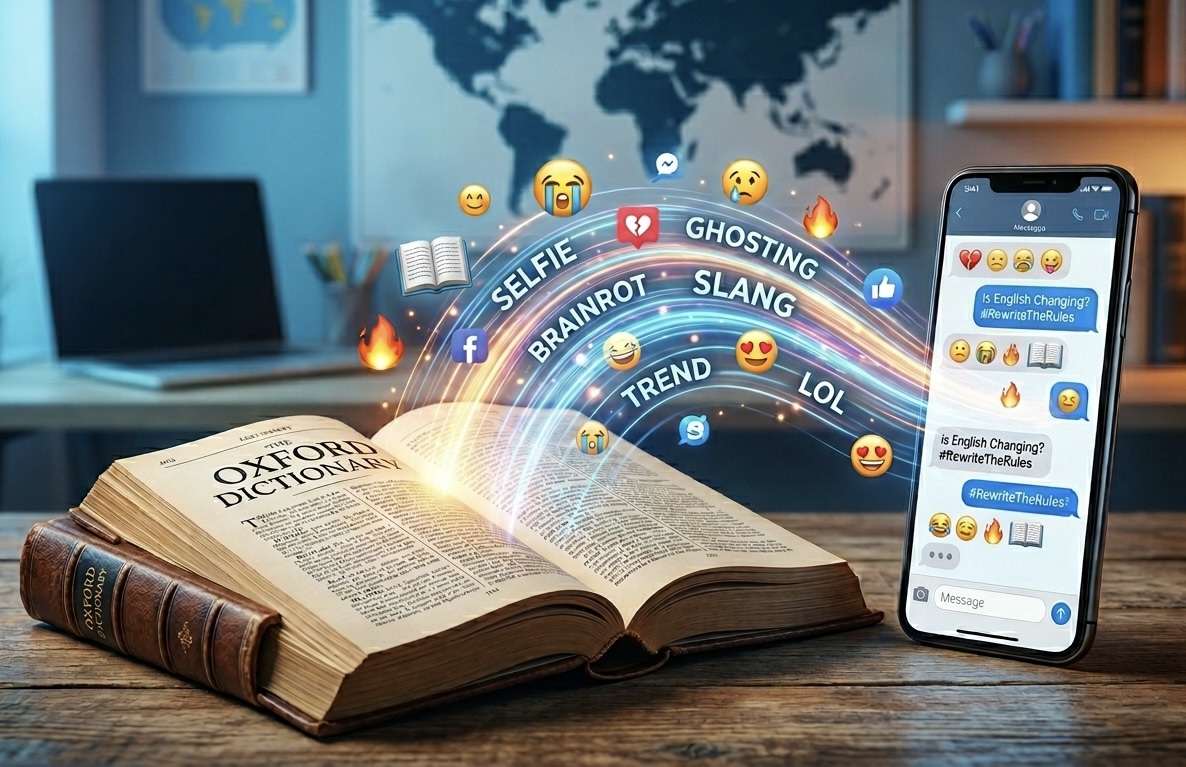
The Rise of "Internet Slang"
In the past, language changed slowly over centuries. Today, thanks to social media platforms like TikTok and Instagram, a new word can become global in just a few hours.
For example, the term "brainrot" or "skibidi" (if you’ve been on the internet lately!) might sound like nonsense to your parents, but they represent a new way of communicating humor and shared experiences. We are moving towards a more visual way of speaking, where a well-placed 💀 or 😭 emoji says more than a thousand words.
Is formal English dying?
Some people worry that students are losing their ability to write formal essays. However, linguists argue that we are actually becoming "multi-lingual" in our own language. We know how to use professional English for school or jobs, and "digital English" for our friends. This is called code-switching, and it’s a sign of high intelligence!
Why this is good for you
As a student learning English, this is an exciting time. You aren't just learning grammar rules; you are witnessing the birth of new expressions. The key is to find the balance: know your "shalls" and "shoulds," but don't be afraid to keep up with the trends.
📚 New Vocabulary (Glosar)
To help you understand the article better, here are some key words to learn:
• To evolve (verb) – to develop gradually, or to change over time.
• Slang (noun) – very informal language that is more common in speech than in writing.
• Global (adjective) – relating to the whole world.
• Nonsense (noun) – words that have no meaning or don't make sense.
• Linguist (noun) – a person who studies languages and how they work.
• Code-switching (noun) – the practice of alternating between two or more languages or styles of speaking.
• Trends (noun) – a general direction in which something is developing or changing.
💡 Challenge for Students!
Can you find 3 new English words that were added to the dictionary in the last year? Write them in the comments below!